How to Use Trading Confluence to Build a Repeatable Edge in 2026
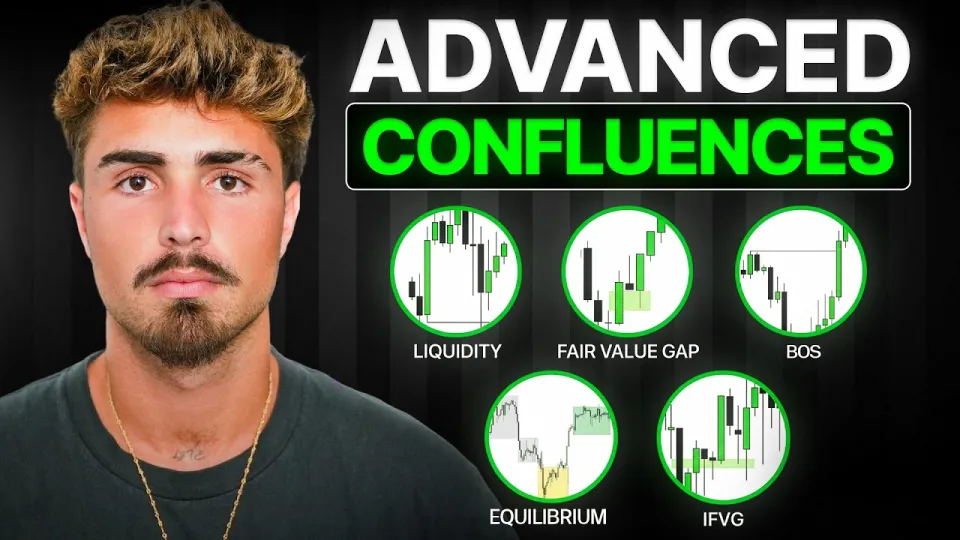
Video: Learn Every Trading Confluence In 18 Minutes
Need articles like this for your video? They help promote it on YouTube and Google — order them in the Telegram bot @sat_sit_bot. Articles with your video embedded are written and posted by the bot itself — on popular topical sites (no ads). Try it free: 50 articles on us.
Trading with confluence means waiting for two or more independent signals — such as liquidity sweeps, fair value gaps, inverse fair value gaps, equal highs or lows, and break of structure — to point at the same price zone before you take a position. The idea is simple: one signal is a guess, several unrelated signals agreeing is a probability. TJR's 18-minute breakdown of every major confluence gives a clean vocabulary for building that checklist, and the free system walkthrough at the TJR blueprint page shows how the pieces are meant to fit into a full plan.
What trading confluence actually means and why it matters
Confluence is the practice of requiring agreement between separate analytical inputs before risking capital. A single candlestick pattern, a single moving average touch or a single support line can fail for no reason at all; when a liquidity sweep, a fair value gap and a structural break all sit in the same 20-point zone, the failure of one signal still leaves the others intact. That overlap is what traders mean when they say a setup is "high confluence".
The trap is treating confluence as a scoreboard. Five weak signals stacked on top of each other do not equal one strong signal, because most of them are measuring the same thing — price direction — and are therefore correlated. Real confluence requires inputs that are structurally different: one about where resting orders sit, one about imbalance, one about market structure.
The five confluences TJR walks through
The video groups the concepts every price-action trader runs into: liquidity, fair value gaps, inverse fair value gaps, equal highs and lows, and break of structure. Each one describes a different mechanical feature of the chart rather than an opinion about direction.
- Liquidity. Clusters of stop orders and pending orders — typically above equal highs or below equal lows — that act as fuel. Price often trades into these pools before reversing, which is why a sweep is treated as a signal rather than a breakout.
- Fair value gap (FVG). A three-candle imbalance where the wicks of candle one and candle three do not overlap, leaving a gap in the auction. Price frequently returns to rebalance part of that gap.
- Inverse fair value gap (IFVG). An FVG that fails — price trades through it and the old imbalance flips role, turning former support into resistance or the reverse.
- Equal highs and equal lows. Two or more highs or lows at nearly the same level, which advertise liquidity and often precede a stop run.
- Break of structure (BOS). A decisive close beyond a prior swing high or low that confirms the current leg of the trend and gives context for everything else.
The order matters. Structure tells you the direction of the leg, liquidity tells you where the fuel is, and the gap tells you where the entry might be. Used backwards — entry first, story afterwards — the same five tools become a rationalisation machine.
How to combine confluences into a checklist that filters instead of confirms
A workable confluence checklist is short, ordered and written down before the session starts. Build it as a sequence of yes/no questions so that a missing answer kills the trade rather than being explained away.
- Context: is there a clear break of structure on your trading timeframe, or is price in the middle of a range? No context, no trade.
- Liquidity: has price just swept an obvious pool — equal highs, equal lows, a session high — or is it approaching one?
- Imbalance: is there an unmitigated fair value gap between the sweep and your target that price still has to fill?
- Confirmation: does the reaction candle close back inside the range, or does an inverse FVG form on the lower timeframe?
- Risk: is the invalidation level close enough that a fixed percentage risk still gives an acceptable reward-to-risk ratio?
If a setup passes three of five, it is not a three-out-of-five trade — it is a no-trade. The checklist exists to remove decisions under pressure, not to give you a reason to click.
Why more confluence does not automatically mean a better trade
The most useful pushback on confluence content is that the skill is knowing which signals actually add value to your specific strategy. A trader scalping a five-minute chart and a trader holding a four-hour swing do not need the same inputs, and a signal that looks powerful in hindsight may add nothing once it is measured.
The test is statistical, not visual. Log every trade with the confluences present at entry, then compare win rate and average reward-to-risk across groups. If trades with an inverse FVG confirmation perform the same as trades without it, that confluence is decoration — remove it and your process gets faster. Most traders discover that two or three inputs carry nearly all of the edge, and the rest simply make them feel safer.
Common questions traders raise about confluence setups
"How long should it take to learn this?" Longer than the video length. Viewers routinely report turning an 18-minute explainer into an hour of notes, and that is the right instinct — but notes are not the same as screen time. Expect weeks of marking up charts before the patterns become recognisable in real time.
"Is the market manipulated?" Price is driven by where liquidity sits, which is why sweeps of obvious highs and lows happen so often. That is not a secret plot against retail traders; it is the mechanical result of stop orders clustering in predictable places. Trading the sweep instead of the breakout is a way of accepting that mechanic rather than fighting it.
"Why do I keep losing even with confluence?" Usually because risk per trade is inconsistent or the invalidation level moves after entry. Confluence improves the quality of the setup, not the discipline of the execution.
"How do I stay consistent?" Treat consistency and self-control as the primary skills and the chart patterns as secondary. A simple setup executed the same way every day beats an elaborate one executed emotionally.
Useful links
- Free system for becoming a consistently profitable trader: https://go.tjrtrades.com/blueprint-nviugv1
- Indicators TJR uses daily: https://go.tjrtrades.com/indicators-6qf6zb4
- Funded account raffle entry: https://form.tjrtrades.com/funded-contest
- Alpha Futures funded accounts (10% off): https://app.alpha-futures.com/signup/TJR/
- Lucid Trading (40% off): https://lucidtrading.com/ref/TJR/
The bottom line on building a confluence-based process
Confluence is a filtering tool, not a prediction tool: liquidity, fair value gaps, inverse gaps, equal highs and lows, and break of structure each describe a different part of the auction, and their overlap raises the odds that a level matters. Start with structure for direction, add liquidity for location, use imbalance for timing, and keep the checklist short enough to run in under a minute. Then measure it — the journal, not the video, tells you which confluences deserve a place in your plan. TJR's 18-minute breakdown is a good map of the vocabulary; the free walkthrough at the TJR blueprint is where the vocabulary turns into an actual system. Day trading is risky and most day traders lose money, so size positions accordingly.
Key takeaways
- Confluence in trading is the overlap of two or more independent signals — liquidity, fair value gaps (FVG), inverse FVG, equal highs/lows and break of structure (BOS) — pointing to the same trade.
- TJR's breakdown 'Learn Every Trading Confluence in 18 Minutes' covers five core concepts: liquidity, FVG, inverse FVG, equal highs/lows and BOS.
- More confluence is not automatically better: each added signal must be independent and must have shown a measurable edge in your own journal.
- A confluence checklist only works with a fixed risk per trade and a written invalidation level set before entry.
- Free system walkthrough: https://go.tjrtrades.com/blueprint-nviugv1
Questions & answers
What does confluence mean in trading?
Confluence means two or more independent signals agreeing on the same price zone before you enter a trade. Typical inputs are liquidity sweeps, fair value gaps, inverse fair value gaps, equal highs or lows, and break of structure. The point is to raise the probability of a setup rather than rely on a single pattern.
How many confluences should a trade have?
There is no fixed number, but fewer, genuinely independent signals usually beat a long list of correlated ones. Log each trade with the confluences present and compare results; if a signal does not improve win rate or reward-to-risk in your own data, drop it from the checklist.
What is the difference between a fair value gap and an inverse fair value gap?
A fair value gap is a three-candle imbalance where the first and third candles do not overlap, leaving an unfilled area price may return to. An inverse fair value gap is that same zone after price has traded through it and it flips role, so former support can act as resistance or vice versa.
Why do traders still lose money when they use confluence?
Confluence improves setup quality but does not fix execution. Losses usually trace back to inconsistent risk per trade, moving the invalidation level after entry, or taking trades that fail the checklist. Consistency and self-control matter more than adding another indicator.
Source: Learn Every Trading Confluence In 18 Minutes · Markdown version